
Brazil Launches AntiDumping Probe on Phosphoric Acid Imports: What It Means for Global Trade
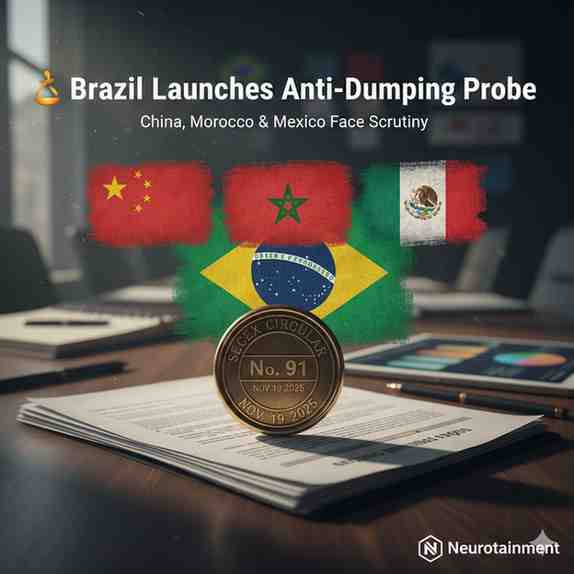
Brazil has officially initiated a new antidumping investigation into imports of purified phosphoric acid originating from China, Morocco, and Mexico. This probe, launched via SECEX Circular No. 91 of November 19, 2025, marks the start of a critical trade defense procedure that could significantly impact the global chemical and food industries.
BUSINESSANTIDUMPINGSTOCK MARKETTRENDING
Neurotainment
11/22/20253 min read

The investigation was initiated based on a petition filed by the domestic Brazilian producer, ICL Aditivos e Ingredientes Ltda..
The Product: Purified phosphoric acid with a concentration greater than 55% and less than 105% of $H_3PO_4$. It is primarily used as a clarifying agent, acidulant, and nutrient in the food and beverage industries, and in the production of food-grade phosphates.
Classification: The product falls under subheading 2809.20.11 of the MERCOSUR Common Nomenclature (NCM).
The Claim: The petitioner alleges that imports from China, Morocco, and Mexico are being dumped (sold at prices below their normal value) in the Brazilian market, causing material injury to the domestic industry.
Key Evidence and Findings for Initiation
The Brazilian authorities found sufficient evidence of both dumping and injury to justify the investigation:
Dumping Margins:
China: US$ 818.60/t (relative margin of 80%).
Mexico: US$ 824.61/t (relative margin of 70%).
Morocco: US$ 710.98/t (relative margin of 65%).
Injury Indicators (April 2020 - March 2025):
Import Growth: Imports from the investigated origins saw a substantial increase of 188.9% from the start (P1) to the end (P5) of the investigation period, displacing both imports from other sources and domestic industry sales.
Market Share Loss: The domestic industry lost market share, with its sales volume in the Brazilian market contracting by 9.8% over the period, despite a 26.9% growth in the overall Brazilian market.
Financial Deterioration: Key financial metrics showed significant worsening, including a 27.6% decrease in gross profit and a 28.2% decrease in operating profit between P1 and P5.
What Happens Next? Key Deadlines
The initiation of the investigation sets in motion a detailed information-gathering phase. Foreign exporters, importers, and other interested parties must adhere to strict deadlines for participation:
Period of Analysis:
Dumping: April 1, 2024, to March 31, 2025 (P5).
Injury: April 2020 to March 2025 (P1 to P5).
Participation: Interested parties must register within twenty days of the circular's publication (published November 21, 2025).
Questionnaires: Known producers, exporters, importers, and other domestic producers will have thirty days from the date of notification to return the investigation questionnaires. Responses submitted within this original 30-day period are crucial for the preliminary determination on provisional duties.
Business Implications
This investigation carries significant weight for companies involved in the production, trade, and consumption of phosphoric acid in Brazil.
For Foreign Exporters (China, Morocco, Mexico)
Immediate and full cooperation with the Brazilian authorities is paramount. Failure to provide complete and timely information can lead to the use of "available facts" (often the petitioner's allegations), resulting in a less favorable outcome, including the potential imposition of high punitive anti-dumping duties.
For Brazilian Importers and Downstream Industries
Anti-dumping measures, if imposed, will lead to higher import costs for purified phosphoric acid. This product is an essential input for the food and beverage sectors (used in soft drinks, yeast nutrients, etc.). Buyers relying on the investigated origins may need to re-evaluate their supply chains to mitigate potential cost increases and supply disruptions.
For the Domestic Industry
The investigation provides an opportunity for the domestic producer, ICL Aditivos e Ingredientes Ltda., to solidify its case. The cumulative analysis of imports from all three origins was deemed appropriate because all dumping margins were non-de minimis, import volumes were significant, and competition conditions warranted it. A favorable outcome could restore market share and profitability by leveling the competitive field.
The final outcome of this investigation will determine whether Brazil imposes definitive anti-dumping duties, which could reshape the country's supply landscape for this critical chemical input for the next five years.
Would you like a summary of the production process for phosphoric acid to provide additional context on the industry being investigated?
For the purpose of constructing the Normal Value for each country, the Brazilian trade defense department (DECOM) used public financial data from the following companies to estimate operating expenses and profit: